A small hand, a big decision
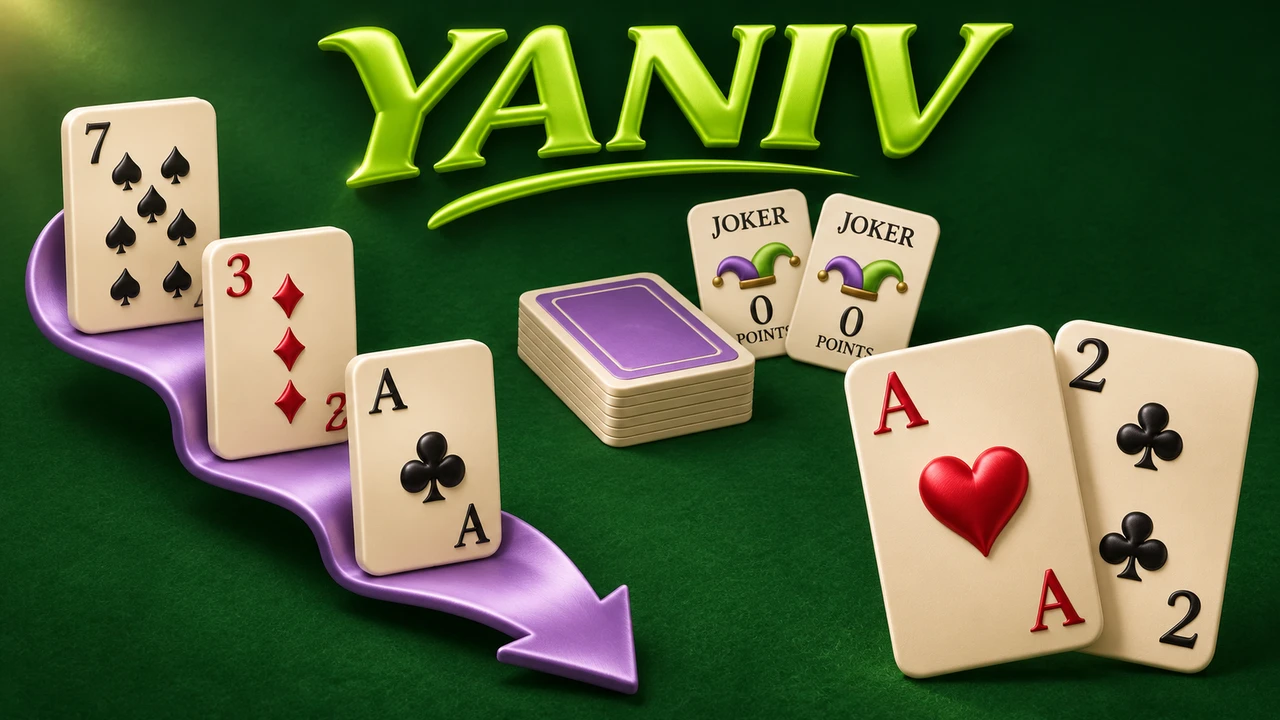
Yaniv is a social card game about reducing the total in your hand, then deciding when to call. The Hebrew reference describes several house-rule families. This version makes one ruleset explicit: seven cards each from a 54-card deck including two jokers. Aces count 1, numbered cards their value, Jack 11, Queen 12, King 13, and jokers 0. There are no stakes or cash prizes.
Discard first, take one
Select one card, two or more equal ranks, or a same-suit run of at least three. Jokers may join equal ranks or fill run gaps; Ace is low only. Then take exactly one card from the blind deck or the previous discard group. Any card in an equal-rank group is available; only the two ends of a run are available. You cannot take your own new discard. Older discards recycle when the blind deck empties. Mixed-suit runs and fast slap-down moves are not used.
Yaniv or Assaf?
At the start of your turn, with 7 points or less, you may call Yaniv instead of exchanging. You succeed only with a uniquely lowest hand and add zero. If any opponent has an equal or lower hand, Assaf is automatic: you add your hand value plus 30. The lowest opposing hand or tied hands add zero; all other players add their hand values. For example, you call with 5 against 5 and 12: you add 35, the tied opponent adds 0, and the third player adds 12.
Winning the match
The round winner opens the next round; tied round winners use seat order. The match ends when anyone exceeds 100 points or after ten rounds. The lowest total wins, with shared wins for ties. This edition has no exact-score reductions or elimination. To bound unusually long rounds, after 300 exchanges all lowest hands win that round without a caller penalty. These are explicit digital house rules, not universal Yaniv rules.
Learn, practice, invite
Start with the guided practice hand, then choose one to three computer opponents and Casual or Tactical play. Select cards with pointer or Tab and Enter/Space, then choose a draw source; Hint selects a high-value legal discard. Solo progress lasts for this visit. Private rooms synchronize two to four signed-in humans: only your hand is visible until the round reveal. The host deals rounds and rematches; reopen the invitation to reconnect. End match ends it for everyone without a winner. Only new solo match wins submit practice points. Game controls are in English; this article is localized.
A practical first strategy
Discard expensive combinations, but watch what opponents take. A low exposed card is reliable; a blind draw may create a useful set. Calling at 7 is legal, not automatically safe: a one-card opponent can easily match or beat you. Keeping a joker reduces points but may delay shedding a large set. This game rewards timing as well as arithmetic.
A little inspiration.
Now make it your own.