For a short solo break, start with Neon Bowling if you want the clearest stopping point, or Star Catcher if you want a one-minute maximum. Prefer thinking to timing? Card Clash, Flux Four and Prism Pop offer different ways to slow down and work through a board. Here is our order for this particular mood.
How we ranked these five games
This is a Tailorgame-authored editorial ranking, checked against the live catalog and interfaces on November 8, 2026. We prioritized an easy-to-understand solo loop, straightforward controls and a clear place to stop. It is not a popularity chart, a timed benchmark or a ranking by total practice points. Match length varies unless a fixed limit is stated.
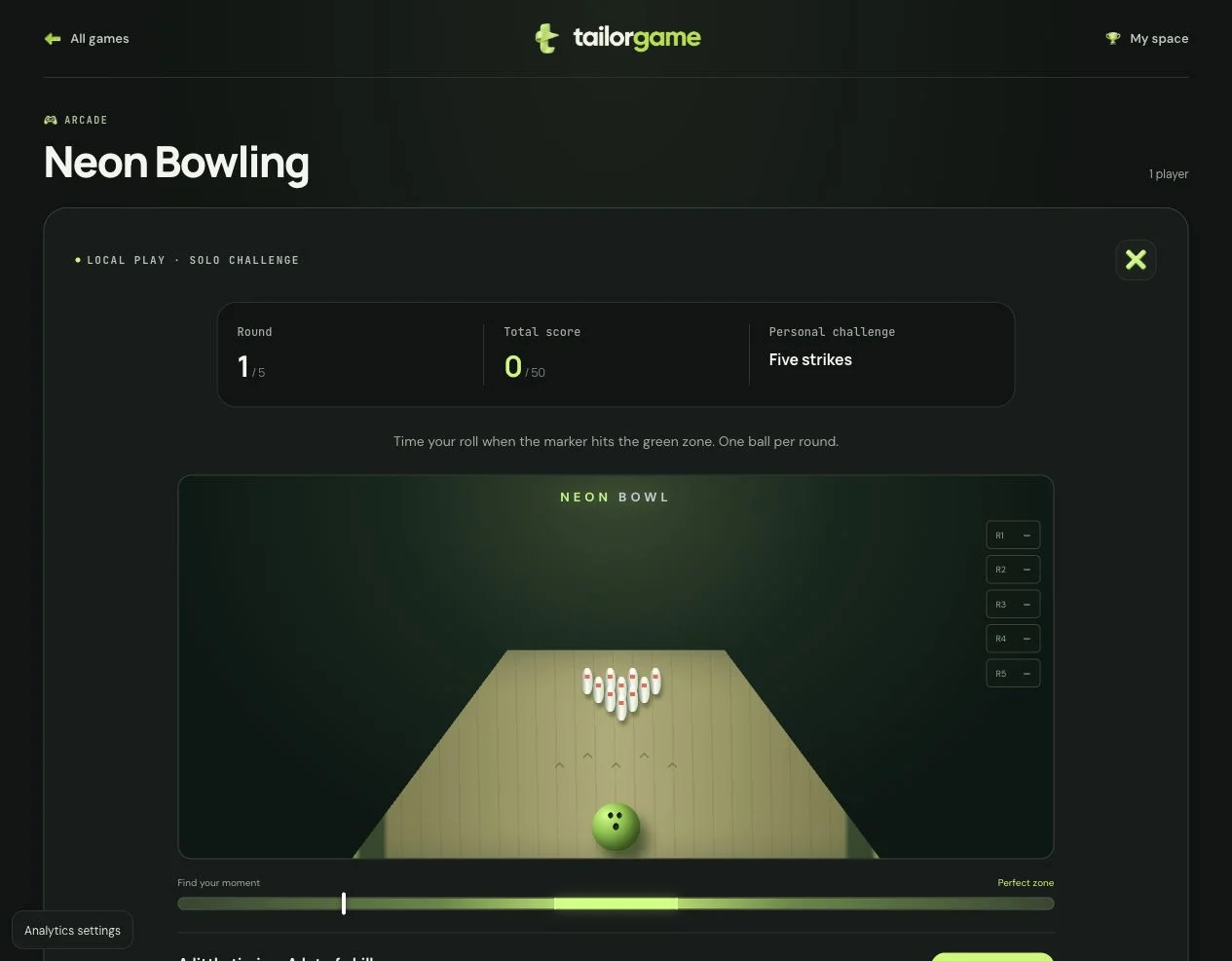
All five picks are currently playable with sign-in. Playing supported games is free; AI creation credits are separate. The screenshots show the actual live player interfaces captured on November 8. We did not complete rounds or submit scores for these captures.
1. Neon Bowling — the clearest stopping point
Five rolls, up to ten pins each, and a total out of 50: Neon Bowling makes a small challenge easy to understand. Watch the moving marker, then use Roll ball when it reaches the green zone. We put it first because the five-roll structure gives your break a natural end. Its limitation is also its appeal: this is a timing challenge, rather than full ten-frame bowling.
Try Neon Bowling, or read the five-roll bowling guide for a little help with the rhythm.
2. Star Catcher — a one-minute burst
Star Catcher gives you up to 60 seconds; three rock hits end the round sooner. Slide the catcher, collect falling stars and avoid the pink rocks while building a multiplier. It earns second place for players who want a clear maximum time and constant movement. The trade-off: a countdown demands more attention than an untimed puzzle. Pick it when a little urgency sounds fun, not when you want to think between moves.
Open Star Catcher when you are ready for a timed round.
3. Card Clash — room to think
Card Clash hides six pairs among twelve cards. Reveal a card, remember its position and look for its partner. Fewer moves produce a higher practice score, without a countdown forcing the next choice. That makes it our first pick for a quieter break. Its finish time depends on your choices and memory; do not mistake an untimed board for a guaranteed two-minute game.
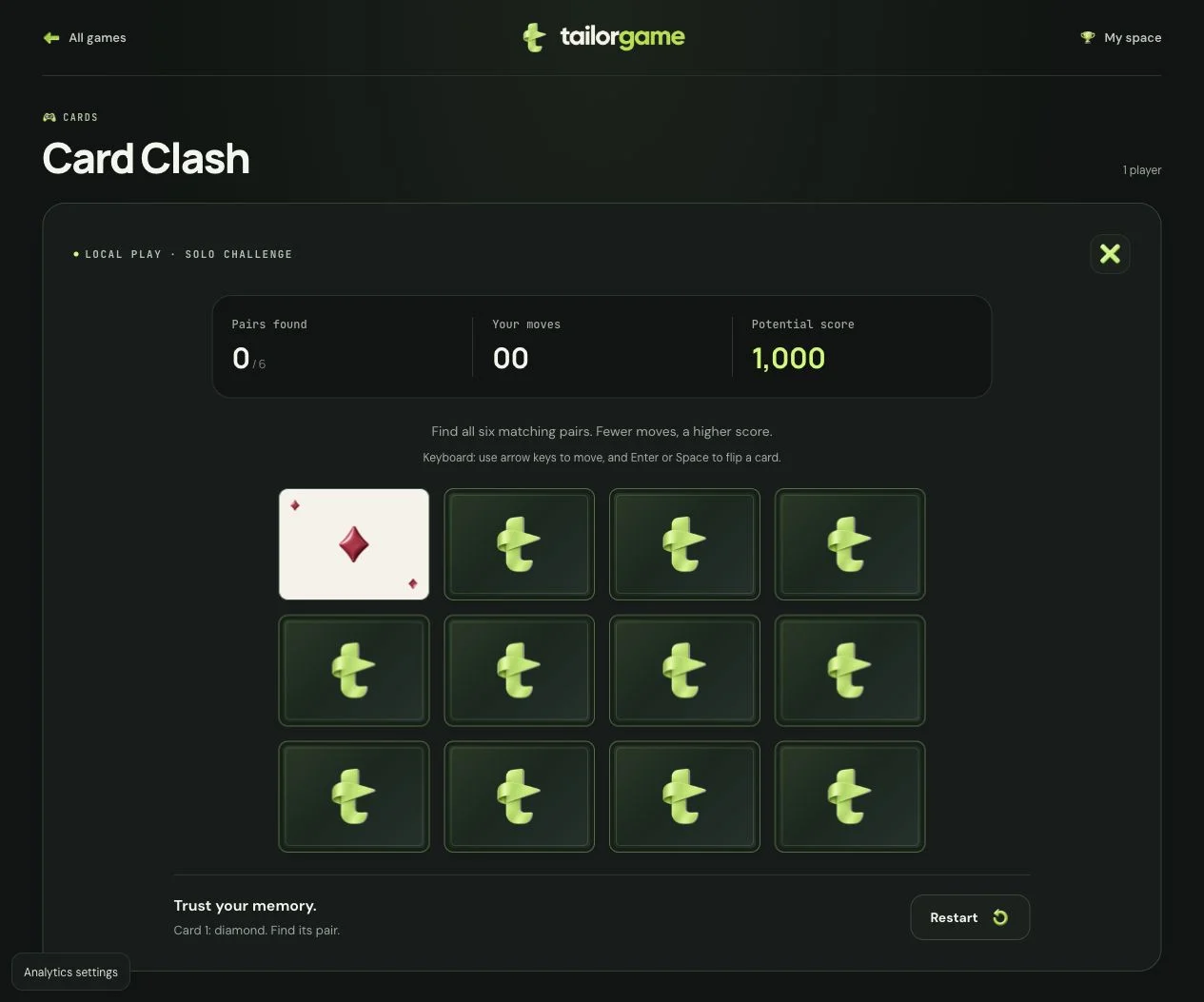
Play Card Clash, then try the memory playbook if you want a more deliberate approach.
4. Flux Four — one extra tactical question
Connect four discs against the computer, with one Pulse available per player. Pulse removes your own bottom disc and shifts that column down, so an apparently settled position can change. We rank Flux Four below the simpler solo loops because you need to consider the opponent as well as your next move. Choose it when your break has room for a small tactical puzzle.
Choose solo play in Flux Four. Its separate online option is a synchronized two-player match; this ranking considers only the computer challenge.
5. Prism Pop — a stage to get lost in
Aim, bounce off a wall and connect three matching bubbles. Unsupported clusters drop, while special bubbles can start chain reactions. Prism Pop places fifth for short breaks because its twelve-stage solo expedition invites a longer visit. You can treat one stage as your goal, but there is no guaranteed completion time. Choose it for angles and satisfying board changes rather than a strict countdown.
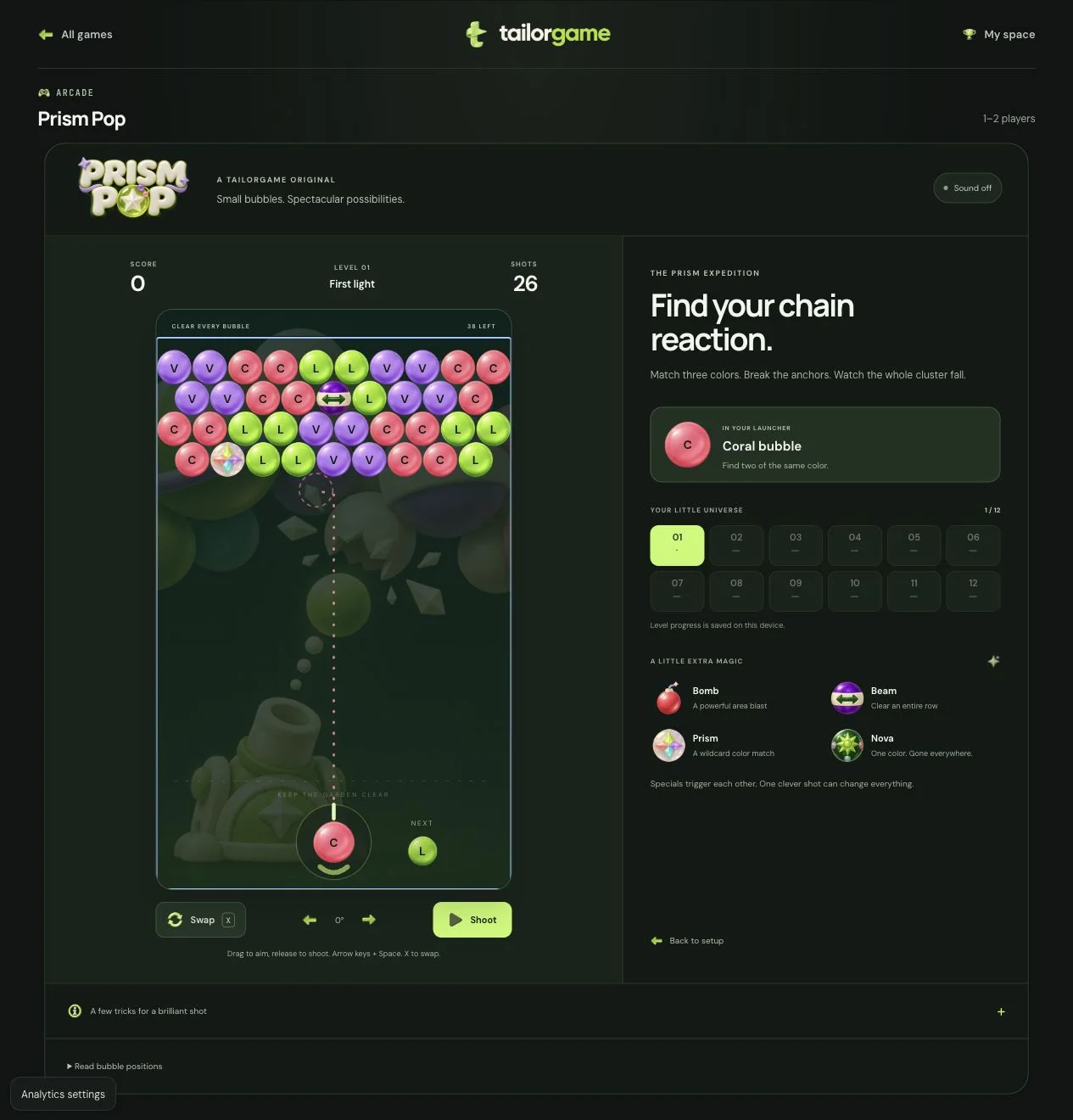
Open Prism Pop for the solo expedition. Its separate two-player mode shares a cooperative board and alternating shots.
Which should you choose, and do scores compare?
Choose Bowling for five defined attempts, Star Catcher for a one-minute maximum, Card Clash for untimed recall, Flux Four for an opponent and Prism Pop for aiming puzzles. Their scoring scales differ, so a larger number does not make one game harder or better. Saved solo scores are browser-reported practice results; this list makes no competitive or most-played claim.
If you would rather plan a shared session, start with the current game catalog and check each game’s actual mode. An invitation room and synchronized gameplay are different features.
A little inspiration.
Now make it your own.