Six cards, one trump suit, and a simple ambition: do not be the last person holding cards. Durak turns that small setup into a lively exchange of attacks, defenses and unexpected extra cards. A modest six can beat an ace when it belongs to the trump suit, while an apparently safe defense can give your opponents a new rank to attack with. Looking for Duroc? The card game is usually spelled Durak in English.
This guide explains Tailorgame’s classic throw-in rules, walks through a sample turn, and separates them from other Durak traditions. You can play our version with two to four seats: invite other platform players, fill open seats with computers, or practice alone against one to three bots.
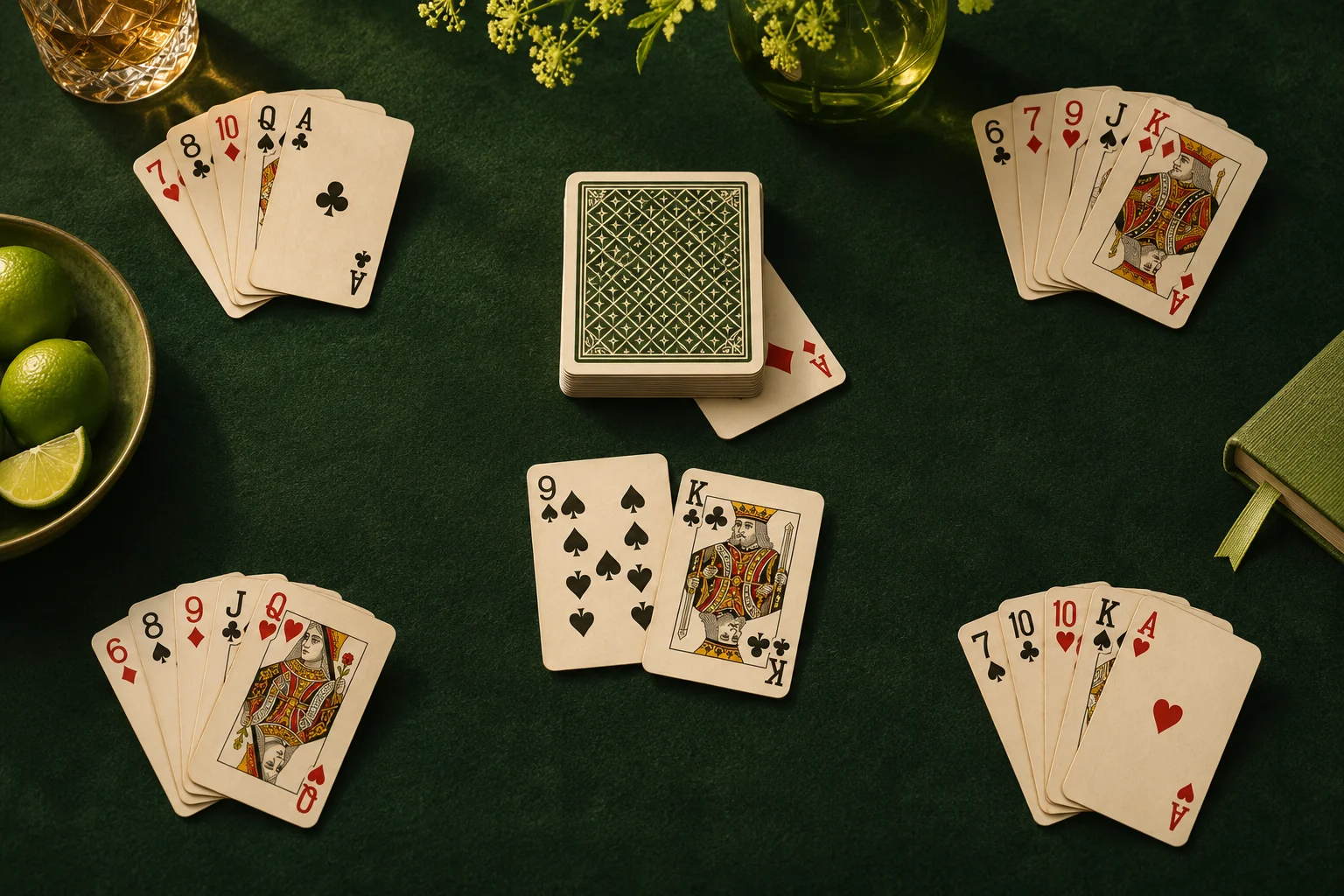
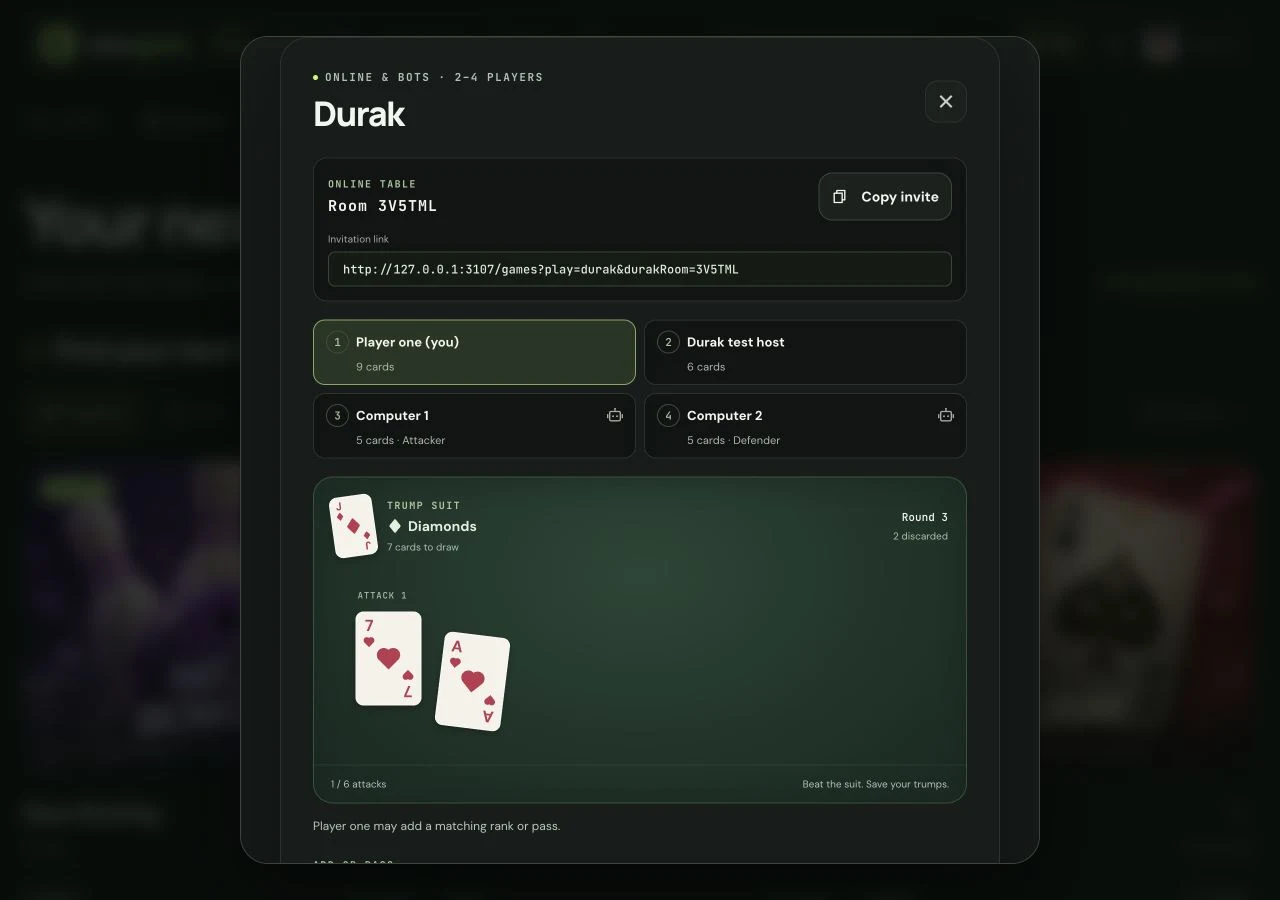
The cover is an original AI-generated illustration of a card-table scene, not a rules diagram or historical photograph. The in-game image below shows an actual demonstration match.
Where Durak comes from
Durak, written дурак in Russian, means “fool”: the name belongs to the player left with cards. It is a family of related games rooted in Russian card-playing culture and played across Eastern and northeastern Europe. Pagat records the Polish name Dureń alongside the Russian forms. The familiar name therefore does not guarantee identical rules at every table.
Its exact invention date and inventor are uncertain. There is clear nineteenth-century literary evidence: in Nikolai Gogol’s The Lost Letter, a grandfather must play cards with witches, and losing makes him the “dourak.” The linked 1890 French translation preserves the game’s name and its use of trumps. That establishes a historical reference; it does not establish when Durak began or prove that those players followed today’s rules.
The game’s enduring appeal is easy to experience: everyone can follow the public table, but nobody knows all the hands. Each defense changes the choices available to the attackers. The result is a social game in which observation and timing matter alongside the deal.
Set up the deck, hands and trump suit
- Use 36 cards: 6, 7, 8, 9, 10, jack, queen, king and ace in each of the four suits. Remove jokers and ranks 2–5 from a standard 52-card pack.
- Deal six cards to each player. Keep the remaining cards as the draw pile, also called the stock or talon.
- Expose one card beneath the stock. Its suit is trump for the entire deal. That exposed card remains part of the stock and is drawn last.
- The player holding the lowest trump opens against the next player clockwise. They may lead any card; they do not have to spend that low trump. Tailorgame uses seat one if no starting hand contains a trump.
Attack, defend and add matching ranks
The attacker opens with one face-up card. To defend, play a higher card of the same suit, or use a trump against a non-trump. An attacking trump can only be covered by a higher trump. Aces are high, and equal ranks cannot beat each other. You may use a trump even when you also hold the attacked suit.
After a defense, attackers may add cards matching any rank already on the table, including ranks introduced by defending cards. Tailorgame gives these opportunities in sequence, with the original attacker first. Play an eligible card or pass. When a new card is played, attackers can receive another opportunity; passing is not a promise never to act again in that bout.
Finish the bout, refill and go out
If every attack is covered and nobody adds another, discard the whole table. Those cards leave this deal, and the successful defender attacks next. If the defender cannot or chooses not to continue, they take the entire table, including cards already used in defense. Attackers may add eligible cards before collection, within the same attack limit. A player who takes skips their next opportunity to attack.
Refill hands toward six after the bout: the original attacker draws first, other attackers follow clockwise, and the defender draws last. Anyone already holding six or more draws nothing. Once the stock is empty, players with no cards leave play. Tailorgame settles the current bout before determining who is out. The last player holding cards is the Durak; if everyone remaining empties their hand in the final successful defense, the game is a draw.
A sample turn: the defense creates another attack
Suppose hearts are trump and Maya defends against Leo. Leo leads the eight of clubs. Maya covers it with the jack of clubs. The available ranks are now eight and jack, so another player, Noor, can add the jack of spades. Maya could cover that with the queen, king or ace of spades, or with any heart.
Maya chooses the six of hearts. Six now joins eight and jack among the ranks that can be added. If nobody continues, all four played cards are discarded and Maya becomes the next attacker after refilling. If Maya had taken instead, she would collect both attacks and the jack already spent defending, plus any further legal throw-ins. This is why a high defense deserves a second thought: it may open a new route into your hand.
The main Durak variants
Podkidnoy Durak is the throwing-in form: matching ranks allow an attack to grow. It is the basis of Tailorgame’s version. With four people, the classic partnership form places teammates opposite one another. A partner cannot add attacks against their own teammate or help defend that teammate’s cards. The team still holding cards after the opposing team goes out loses. Team play changes whose success you are trying to protect.
Perevodnoy Durak adds transfers. Before covering an attack, a defender may lay another card of the attacking rank and pass the enlarged attack to the next player. That next defender must hold enough cards to face it. Further matching transfers can send the attack around the table, but in the standard form a defense already begun cannot be transferred. A matching trump can be used to transfer or to defend: those are different decisions.
Prostoy Durak means simple Durak, but it is a separate ruleset rather than an easier difficulty setting. Pagat’s documented version deals five cards and permits attacks of one, three or five cards in specified combinations. A defender may discard successfully covered pairs while taking only the uncovered attacks. That differs substantially from taking the whole table in the throw-in game described above. Agree on the complete rules before choosing a familiar-sounding name.
House rules to agree before dealing
Families and playing groups add their own conventions. The Hebrew Durak overview describes alternatives including a five-card limit for the first successful defense, larger attacks, and exchanges involving the exposed trump. Some groups use larger decks or combine transfer and partnership rules. Treat these as optional agreements. A rule remembered from another table is not automatically part of the game you have just joined.
Three habits that improve your decisions
- Notice ranks before choosing a defense. Covering a seven with a queen makes queens eligible for follow-up attacks. The cheapest legal defense is a useful starting point, but check which ranks it exposes.
- Keep track of trumps you have seen. A low trump can answer a powerful non-trump, so spending it early has a cost. Conversely, taking a large table just to preserve one trump can leave you with more work later.
- Change priorities when the stock runs out. Early attacks make room to draw; late attacks must help you actually empty your hand. Watch the next defender’s card count and plan how your remaining suits might leave your hand.
Play Durak on Tailorgame
Sign in and open Durak. Choose “On this device” for solo practice against one to three computers, or configure local human seats for pass-and-play. For separate devices, choose “Online with friends,” create a two-, three- or four-seat room, and share its invitation link or code. Friends join before the host starts; computers fill any unoccupied seats when the cards are dealt.
Online turns and cards are synchronized, and each player sees their own hand. Rejoin with the same account and room code to return to your seat. If you need to stop during a match, you can hand your seat to a bot so the others can continue. Online results remain in the room and do not add practice points to profiles.
A little inspiration.
Now make it your own.