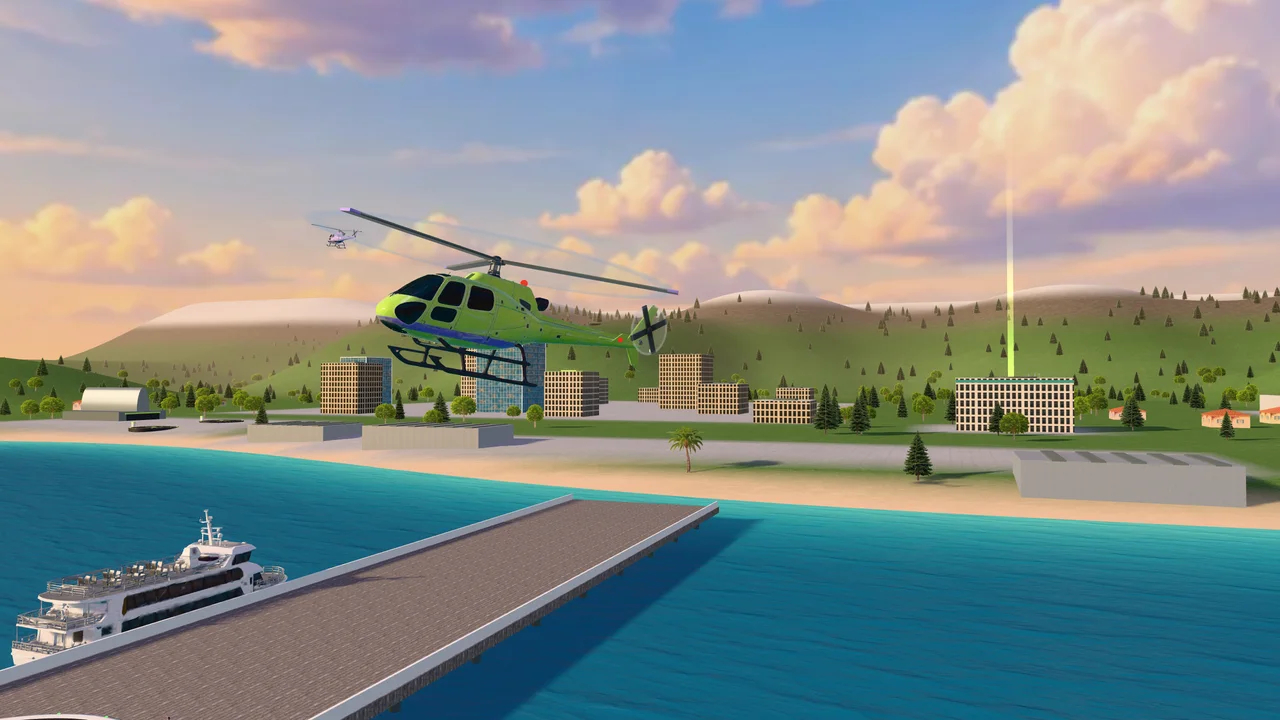
Rotor Harbor is an original 3D helicopter air-taxi game. You fly a light utility helicopter around a harbor city, land on rooftop, pier, island and hilltop helipads to pick passengers up, and carry them to their destinations for fares and tips. The money buys a faster engine, a stronger rotor, a bigger fuel tank, more seats and tougher skids.
Flying the helicopter
W or Up flies forward and S or Down brakes and reverses. A and D, or Left and Right, turn. Space or E climbs and Shift or Q descends. You cannot taxi on the ground, so lift off before you move. C switches between the chase camera and a high landing camera, and you can drag the view to look around. On a touch screen, the stick flies and turns and the Up and Down buttons change height. A gamepad works too: the left stick flies and the triggers climb and descend. The game runs in the browser with no download; text inside the game is in English.
Picking up and dropping off
Lime light columns mark helipads with waiting passengers, and the arrow at the top of the screen points to the best pickup or your next drop-off; raised pads show their height. Land on the pad and stay parked. A party boards only if it fits your free seats, and lifting off early cancels boarding. Violet columns mark where your passengers are going. Land there and stay parked while they get off and pay. Waiting parties of one to three people give up after roughly one to two minutes.
Fares and tips
A fare is $30 plus $0.13 for every meter between the two helipads, multiplied by 1.7 for a party of two and 2.4 for a party of three. Commuters tip 15% for a quick trip. Express parties pay 50% extra if they arrive before their timer runs out. VIPs pay one and a half times the standard fare and tip another 45% of it if they never felt a hard landing or a collision. Every party adds $10 for a gentle touchdown at its destination, slower than 1.5 meters per second.
Fuel, damage and tows
Flying burns fuel; the gauge sits beside the shift clock. Park on a Heliport pad, or on the Sea Rig offshore, to refuel. Fuel costs $0.80 per unit and is billed at the end of the shift. Hard touchdowns and collisions with buildings cost hull strength, although a ground cushion slows a held descent in the last few meters. Landing in the water costs $180, losing all hull strength costs $250 and running out of fuel away from a fuel pad costs $120. Each of these ends with a tow back to the Heliport, and any passengers aboard are lost. If the tank runs dry in the air, the helicopter comes down slowly.
Shifts, licenses and upgrades
A solo shift lasts four minutes, and you can end one early while parked at the Heliport. Between shifts, the hangar sells upgrades. The turbine engine raises top speed from 34 to 62 meters per second over four levels. The rotor system improves climbing, acceleration and turning. The fuel tank grows from 110 to 260 units. The cabin seats two, three, four and then six passengers. Stronger skids raise the safe touchdown speed and the hull. Repairs cost $2.50 per hull point, and liveries change only the paint.
Lifetime fares and tips unlock pilot licenses. Coastal Charter, at $2,500, adds Lighthouse Point and Palm Key Resort. Island Air, at $8,000, adds Summit Lodge, Observatory Ridge and the Sea Rig. At $20,000 you become a Harbor Legend. That completes the career and saves practice points once: 5,000, plus 300 for every shift under 30 and 10 per passenger, between 2,000 and 20,000. Your career is saved on this device as recordings that are replayed and checked when you continue.
Rival Charters online
Rival Charters is for exactly two signed-in people in a private room. Create a room and share its invitation link; the host starts the match after a short countdown. Both pilots fly the same harbor at the same time for three minutes in identical helicopters with a level-two engine, three seats and 150 units of fuel, starting from separate Heliport pads. Passengers are shared: a party belongs to whichever pilot the server sees boarding it first. Your browser sends your controls in small batches, and the server replays every batch with the same rules before it counts. The other helicopter appears about a second behind its verified path, and helicopters do not collide with each other.
The higher net cash, meaning fares and tips minus fees and fuel, wins; equal cash is a draw. If the other pilot stops sending, you can close the match 45 seconds after the three minutes end. Online results stay in the room and never award practice points. The host can start a rematch.
Comparing helicopter games? 6 helicopter games for flying passengers: Rotor Harbor is our editorial pick
About the game
Rotor Harbor is an independent original game built with the PlayCanvas engine. Its helicopter is modeled on a reference photograph of a light single-engine utility helicopter, without real markings. Its harbor city, passengers, economy and Rival Charters are original.
A little inspiration.
Now make it your own.